

























University of Oxford Study: Plant-Based Diets May Reshape Farming Jobs
A new study by the University of Oxford finds that a global shift toward plant-based diets could reduce agricultural labour needs by 5 %–28 % (18–106 million jobs) by 2030, with major impact on livestock-intensive nations and opportunities rising in fruit, vegetable and legume production.

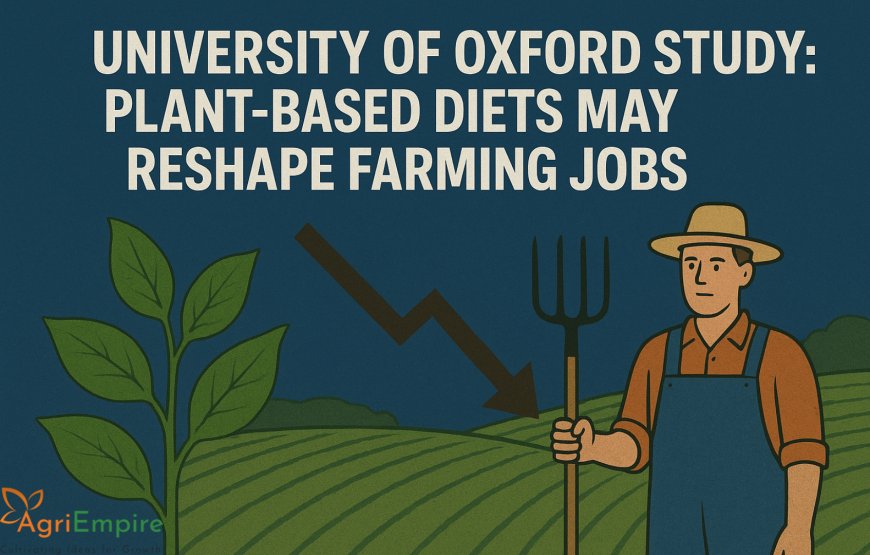
A major new report from the University of Oxford’s Environmental Change Institute has revealed that global adoption of more plant-based diets could dramatically alter employment in agriculture. According to the modelling in the study, if dietary trends shift as forecast, labour requirements in the farming sector could fall by between 5 % and 28 % by the year 2030 — equivalent to between 18 to 106 million full-time jobs worldwide. The largest employment declines are projected in livestock-intensive countries, while other regions may see increased horticulture demand.
The analysis highlights that meat, dairy and other livestock production require significantly more labour, inputs and land per unit of output than fruit, vegetables, legumes and plant-based proteins. As consumers in middle-income countries adopt diets richer in varied plant foods, the labour profile of agriculture is expected to shift. For nations highly dependent on livestock exports, such as Australia, New Zealand, parts of Canada and the U.S., the study warns that structural adjustment will be essential.
Researchers note that this transition offers both risks and opportunities. While lower-income countries specialising in animal farming may face job losses, horticulture-oriented regions could experience growth — an estimated 18–56 million additional full-time jobs might be needed globally to grow more fruits, vegetables and nuts. The study emphasises that policy frameworks must support retraining, redeployment and infrastructure in emerging value-chains, otherwise vulnerable farming communities could be left behind.
Beyond employment, the shift has significant implications for food systems, climate policy and rural livelihoods. The report estimates potential savings of US $290 billion to $995 billion annually in global agricultural labour costs, or about 0.2–0.6 % of global GDP. However, the authors stress that such gains must be managed to ensure equitable transitions, particularly for regions where agriculture remains the main employer and income source.
In light of the findings, the authors call on governments and industry to invest now in “just transition” strategies for farming communities. Suggested interventions include promoting crop diversification, supporting regenerative agriculture, enhancing skills in horticulture and food-value chains, and anticipating labour market shifts rather than reacting post-shock. As one researcher put it: “Changing what we eat changes how we farm, and that will change who works on farms.”