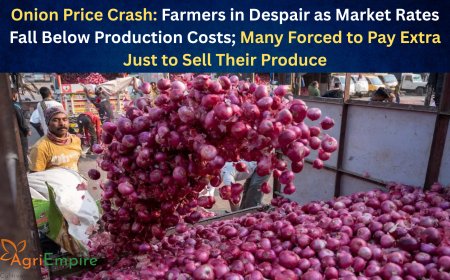




















Onion Price Crash: Farmers in Despair as Market Rates Fall Below Production Costs; Many Forced to Pay Extra Just to Sell Their Produce
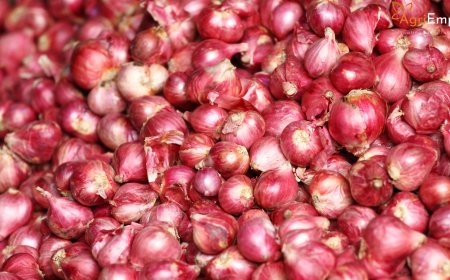
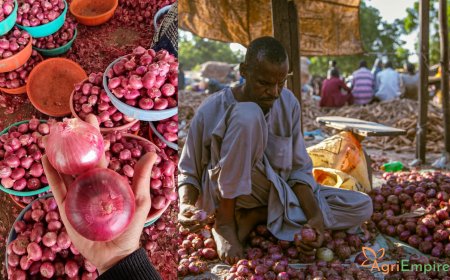
The onion crisis in Maharashtra has reached a critical point as of May 12, 2026. While the cost of production has surged to ₹1,600–₹1,800 per quintal, market rates are hovering between ₹800 and ₹1,100, leaving farmers with a net loss of nearly ₹40,000 per acre. In shocking incidents, some farmers received no money after deductions, while others had to pay from their pockets to cover market fees.

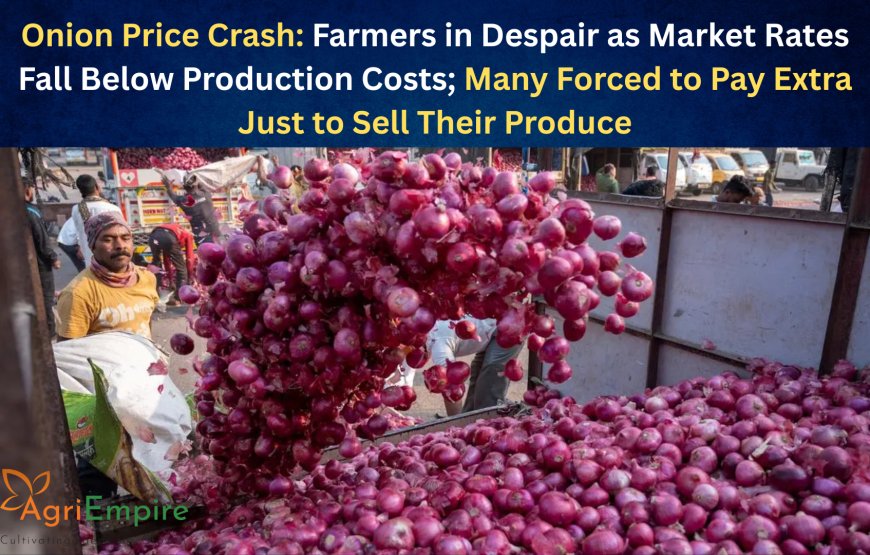
The "King of Vegetables" has brought Maharashtra’s farmers to tears this season. As of May 12, 2026, the disparity between rising input costs and plummeting market prices has pushed onion growers into a deep financial abyss. At the Lasalgaon APMC, the world’s largest onion market, average prices for Summer (Unhal) onions are currently fluctuating between ₹800 and ₹1,100 per quintal. This is significantly lower than the estimated production cost of ₹1,700–₹1,800, causing a direct loss of nearly ₹700 per quintal.
The crisis has led to several tragic and viral incidents across the state:
-
Paithan (Varudi): Farmer Prakash Galdhar sold 1,263 kg (12 quintals) of onions but received zero rupees in hand. In fact, after deducting weighing and labor charges, he had to pay ₹1 to the market committee from his own pocket.
-
Satana: A frustrated farmer attempted suicide at the market yard after his produce fetched only 50 paise per kg (₹50 per quintal).
-
Lasur Station: Farmers halted auctions for four hours after prices crashed to as low as ₹100 per quintal.
Growers argue that the government's export policies are inconsistent. While exports are officially "open," various conditions and minimum export prices (MEP) make it difficult for Indian onions to compete in the global market. Furthermore, procurement by agencies like NAFED and NCCF is being criticized as "eyewash," with farmers claiming that traders benefit more from these schemes than the actual producers.
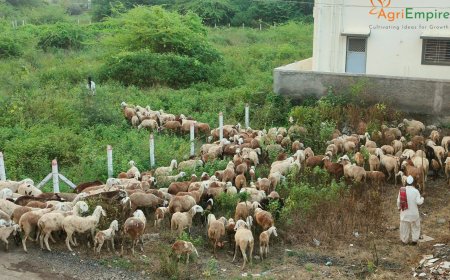
Distressed farmers from regions like Yeola, Niphad, and Chandwad are now demanding a subsidy of at least ₹1,000 per quintal to stay afloat. Some have even resorted to extreme measures like letting sheep graze on standing crops or using rotavators to destroy ready-to-harvest onions, as the cost of harvesting is higher than the expected market return. Without immediate and transparent government intervention, the agricultural economy of the state's "onion belt" faces a complete collapse.